Garbage Sorting and House Rules in Japan: What Newcomers Should Know
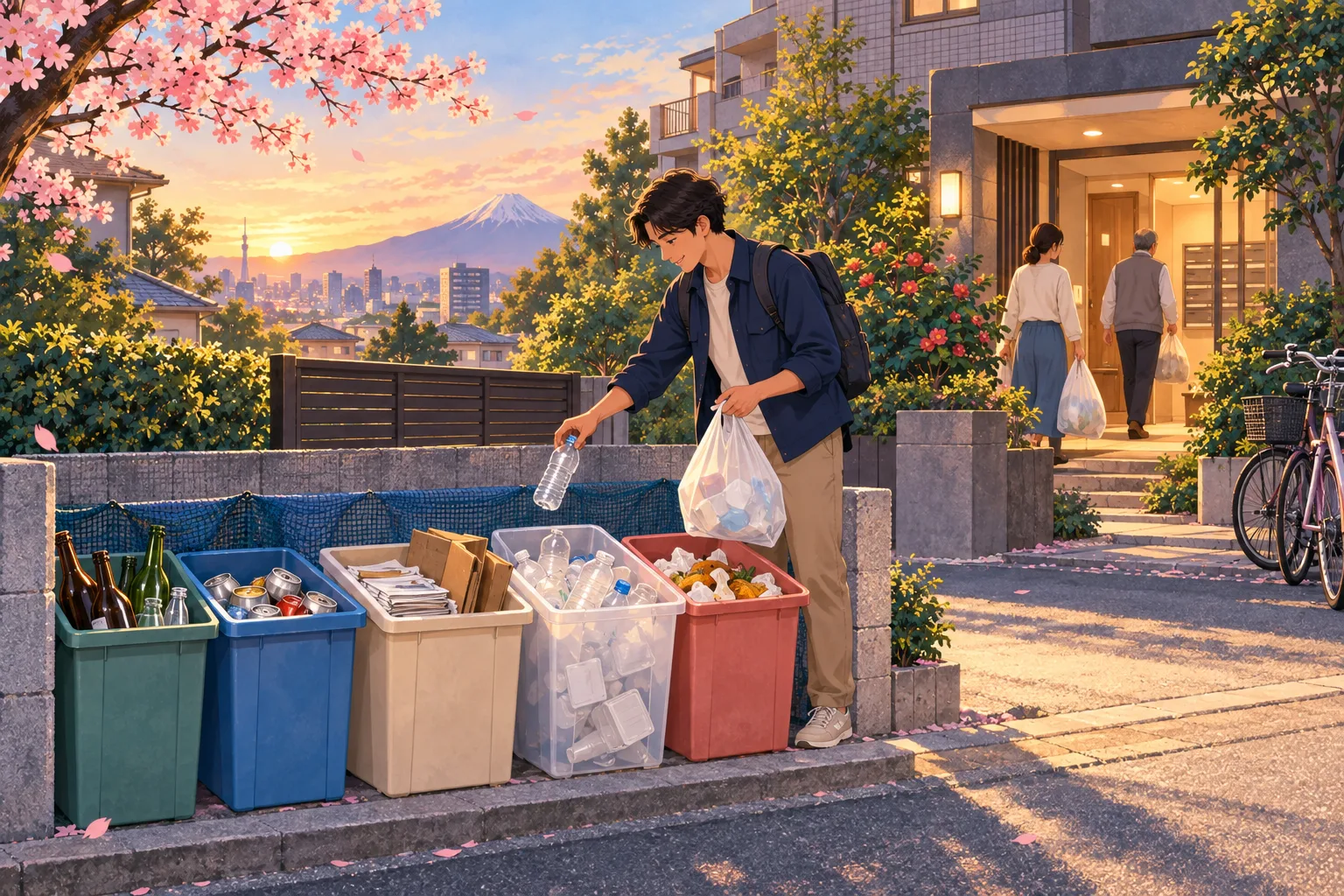
Japan has detailed rules for garbage, and most apartments and share houses have rules for daily life too. Most of them are simple once you know them, and following them is one of the best ways to get along with your neighbors and your landlord. This guide covers the basics.
The short answer
- Sort your garbage by type, and put each type out only on its collection day.
- The rules are set by your city or ward, so get the guide for your area.
- Keep noise down late at night, and follow your building’s rules for shared spaces.
Garbage: the general idea
Each city or ward decides how garbage is sorted and when it is collected, so the details change from place to place. But most areas use similar groups:
- Burnable garbage (moeru gomi): food waste, paper that cannot be recycled, and some other items. Usually collected twice a week.
- Non-burnable garbage (moenai gomi): metal, glass, and ceramics that cannot be recycled. Usually collected less often.
- Recyclables: plastic bottles (PET bottles), cans, glass bottles, and paper. Each type is often collected on a different day.
- Plastic packaging: in many areas, plastic containers and wrapping are a separate group.
- Bulky trash (sodai gomi): furniture and other large items. You usually need to book a pickup and pay a fee.
How to put garbage out
- Put it out on the right day. Put garbage out on the morning of its collection day, before the time set by your area. Putting it out the night before is not allowed in many areas.
- Use the right place. Your building usually has a collection point or garbage room, or shares one with the neighborhood. Ask your landlord or share house operator where it is.
- Use the right bags. Some cities require special garbage bags, which you buy at supermarkets and convenience stores. Others accept clear or semi-clear bags.
- Prepare recyclables. Rinse bottles and cans, remove caps and labels from plastic bottles, and flatten boxes.
If garbage is put out on the wrong day or sorted the wrong way, the collectors may leave it there with a warning sticker. That is a sign to check the rules again.
Where to find your local rules
Search online for your city or ward name plus the word “garbage” (for example, “Shinjuku garbage”), or ask at the city or ward office when you register your address. Many cities publish their garbage guides and collection calendars in English and other languages. The Council of Local Authorities for International Relations (CLAIR) also offers information about daily life in Japan in many languages.
Noise and neighbors
- Late at night. Keep your voice, music, and TV low. Many buildings ask you not to use washing machines or vacuum cleaners at that time.
- Footsteps. Footsteps can carry to the room below, especially in wooden buildings. A rug or slippers can help.
- Overnight guests. Check your contract or house rules before inviting friends to stay over.
Other common rules
- Shared spaces. Do not leave shoes, bikes, or boxes in hallways and stairways. They can block the way out in an emergency.
- Balconies. Many balconies have a thin partition panel between you and your neighbor, or an escape hatch in the floor. Do not put things in front of them, because they are used to escape in an emergency.
- Who can live there. Only the people on the contract may live in the apartment. Letting someone else move in without permission goes against your contract.
- Smoking and pets. Many places do not allow pets. Many also do not allow smoking, or allow it only in certain areas. Check before you sign.
Living in a share house
On top of the local garbage rules, share houses have their own house rules, such as cleaning duties, quiet hours, and rules about guests. In many houses, the operator or cleaning staff take care of the shared garbage area, but you still need to sort your own garbage. Ask about the rules before you move in. To learn what to check, read our guide: How to Choose a Share House in Japan: 8 Things to Check.
Sources
- Council of Local Authorities for International Relations (CLAIR), Multilingual Living Information. clair.or.jp

